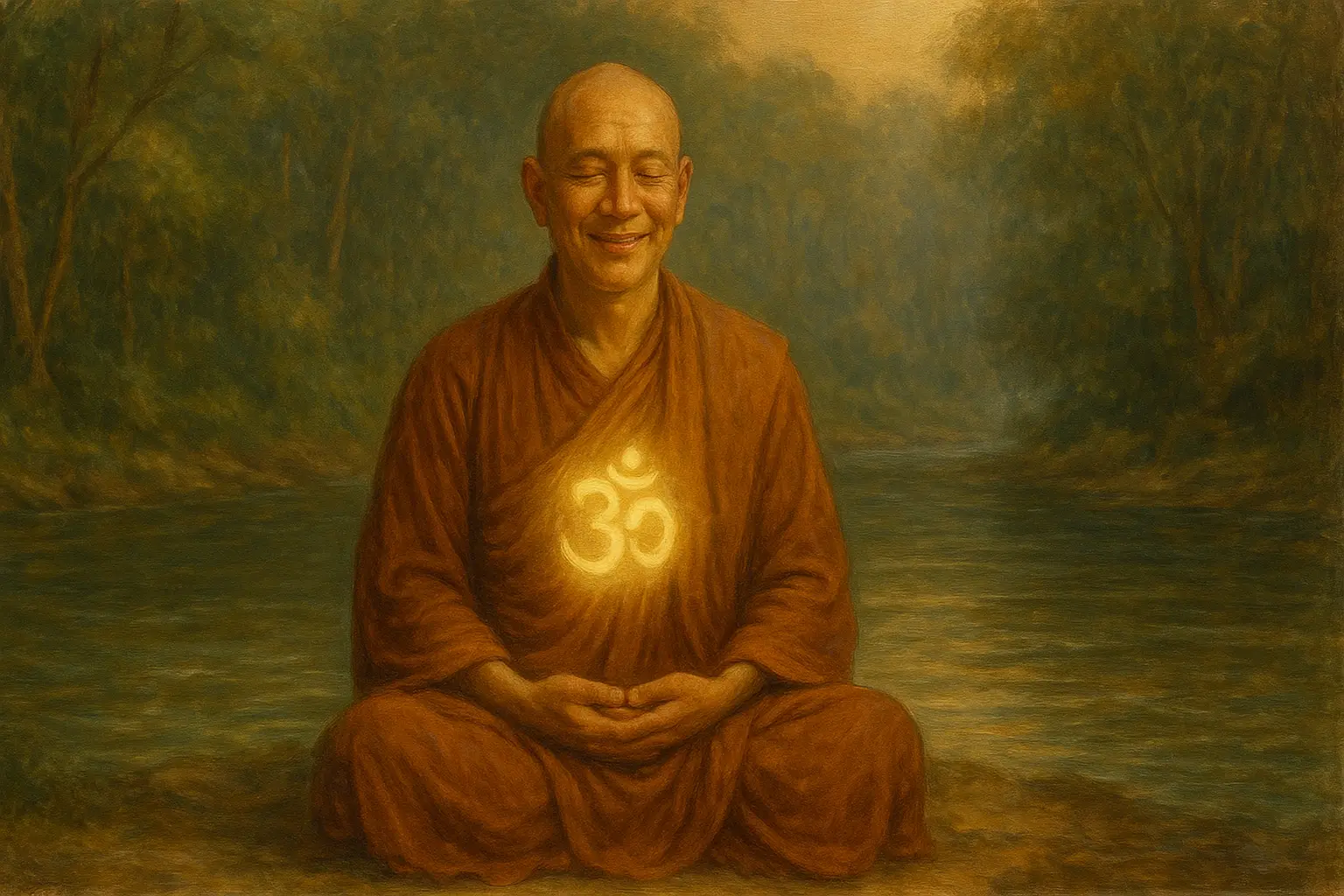
In the journey of spiritual awakening, perhaps no question is more fundamental than "Who am I?" This ancient inquiry, central to Advaita Vedanta, invites us to look beyond the surface layers of identity and discover our true nature - the Atman.
Beyond Body and Mind
Most of us identify ourselves with our physical body, our thoughts, emotions, and memories. We say, "I am tall," "I am sad," or "I remember my childhood." But Advaita Vedanta invites us to examine this identification more closely.
The body changes constantly - every cell is replaced over time. The mind fluctuates between different states - waking, dreaming, deep sleep. Our emotions come and go like clouds in the sky. If we are truly these changing phenomena, then what maintains our sense of continuous identity?
The Witness Consciousness
There is something
within us that remains constant - the witness of all these changes. This witness consciousness observes the body aging, thoughts arising and passing away, emotions flowing through us. It is present in waking, dreaming, and even gives us the awareness that we slept peacefully.The Nature of Atman
According to Advaita Vedanta, this witnessing consciousness is our true Self - the Atman. It has three fundamental characteristics:
Sat (Existence)
The Self is pure existence. It doesn't come into being or cease to exist. It is the very ground of being itself, the "I Am" that gives reality to all our experiences.
Chit (Consciousness)
The Self is pure consciousness - not consciousness of something, but consciousness itself. It is self-aware, self-illuminating, requiring nothing external to know its own existence.
Ananda (Bliss)
The Self is inherently complete and fulfilled. It lacks nothing and desires nothing. This natural state of contentment is not dependent on external circumstances.
The Great Recognition
The ultimate teaching of Advaita is that this individual Self (Atman) is not separate from the universal consciousness (Brahman). The wave is not different from the ocean; the space inside a pot is not different from the space outside.
This recognition - that our deepest Self is identical with the ultimate Reality - is not merely intellectual knowledge but a direct, immediate knowing that transforms our entire understanding of existence.
Practical Implications
Understanding our true nature has profound implications for daily life. When we recognize that we are not the body-mind complex but the eternal witness, we naturally develop:
Detachment without indifference - We can engage fully with life while remaining unshaken by its ups and downs.
Compassion - Recognizing the same Self in all beings naturally gives rise to love and understanding.
Fearlessness - When we know our true nature as eternal and unchanging, the fear of death and loss begins to dissolve.The path to this understanding involves both intellectual study (Sravana) and direct inquiry (Manana and Nididhyasana). It requires patience, sincerity, and often the guidance of a qualified teacher.
The journey of self-discovery is the most intimate and transformative adventure we can undertake. It leads us from the fragmented perception of a separate self to the unified vision of our true nature - eternal, infinite, and one with all existence.